Glaucus atlanticus
Forster, 1777
Order: NUDIBRANCHIA
Suborder: AEOLIDINA
Family: Glaucidae
DISTRIBUTION
Circumglobal in temperate and tropical waters.
PHOTO
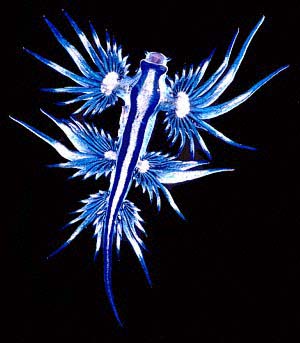
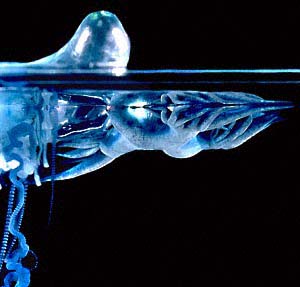
UPPER: Collaroy Beach, Sydney, February 1987. 4cm long alive. Photographed from above to show the modified foot. Note: as these animals float upside down, their foot is always dorsal. LOWER: Feeding on the "Portuguese man-of-war" or "Bluebottle", Physalia.
PHOTOS: Bill Rudman.
RELATED TOPIC
Glaucus atlanticus and its close relative, Glaucilla marginata, live in close association with what Sir Alistair Hardy described many years ago as "The Blue Fleet" - the siphonophores such as Physalia, Velella, Porpita and the other associated animals including the "Violet snails" of the genus Janthina. All these animals float on the surface of the ocean being carried by the currents and the winds. Most of us are only aware of their existence when days of onshore winds blow great fleets of them on to the beaches, causing pain and angst for swimmers.
Both species spend their life floating upside down in the water, partially bouyed by a gas bubble in their stomachs.
The two nudibranchs feed almost exclusively on Physalia, and as Tom Thompson and Isobel Bennett reported some years ago, it appears that they are able to select the most venomous of Physalia's stinging nematocysts for their own use. Like most aeolids, they store the nematocysts in special sacs (cnidosacs) at the tip of their cerata .
There are a number of reports in Australia of kids engaged in "Bluebottle" fights - where they throw stranded Physalia at each other - being badly stung by inadvertently playing with Glaucus and Glaucilla, both of which, by concentrating the most venomous of Physalia's nematocysts, are much more deadly.
Another interesting feature of the two species is their colouration. They both exhibit a textbook example of colour countershading. Their foot and undersides of the cerata, (which because they float upside down is effectively their dorsal surface), is blue or blue and white which helps to camouflage them from predation (sea birds) from above. Their true dorsal surface, which faces down in the water, is silvery grey to effectively camouflage them from fish looking up from below.
See photos of pelagic egg strings.
References:
• Bergh, L.S.R. (1884) Report on the Nudibranchiata dredged by H.M.S. Challenger during the years 1873-1876. Report of the Scientific Results of the Voyage of H.M.S. Challenger during the years 1873-76, ... Zoology, 10(26): 1-154, pls. 1-14. [Glaucus: p.10-16]
• Forster, G. (1777) A voyage round the world in His Britannic Majesty's sloop, Resolution, commanded by Capt. James Cook, during the years 1772, 3, 4, and 5 by George Forster. Vol 1: p49.
• Thompson, T.E. & McFarlane, I.D., 1967. Observations on a collection of Glaucus from the Gulf of Aden with a critical review of published records of Glaucidae (Gastropoda, Opisthobranchia). Proceedings of of the Linnean Society, 178: 10-123.
• Thompson,TE. & Bennett,I., 1969. Physalia nematocysts: Utilised by mollusks for defense. Science, 166: 1532-1533.
• Thompson,TE. & Bennett,I., 1970. Observations on Australian Glaucidae (Mollusca: Opisthobranchia). Zoological Journal of the Linnean Society, 49: 187-197.
Rudman, W.B., 1998 (November 6) Glaucus atlanticus Forster, 1777. [In] Sea Slug Forum. Australian Museum, Sydney. Available from http://www.seaslugforum.net/factsheet/glauatla
Related messages
-
Glaucus from South Africa
From: Emil H Niksch, May 3, 2010 -
Glaucus atlanticus from Florida
From: Stephanie Armentrout, April 30, 2010 -
Glaucus atlanticus from nthn New South Wales
From: Jayson Dyer, April 23, 2010 -
Re: Glaucus atlanticus from Florida
From: Douglas Hernandez, April 6, 2010 -
Glaucus atlanticus from Florida
From: Emma C., April 5, 2010 -
Blue Bottles and Nudibranch washed up at Kiama, NSW
From: Cherie Noon, March 24, 2010 -
Glaucus atlanticus in Hawaii
From: Aaron Silva, January 29, 2010 -
Glaucus atlanticus find in Northern NSW Australia
From: Matthew Ross, January 20, 2010 -
Glaucus atlanticus from Hawaii
From: Enjoli' Hoskins, September 8, 2009 -
Occurrence of albino Glaucus atlanticus?
From: Evan Orellana, August 31, 2009 -
Glaucus atlanticus from Pacific coast of Panama
From: Clark Misner, May 14, 2009 -
My Glaucus atlanticus Report
From: Kenneth Hattersley, May 14, 2009 -
Glaucus atlanticus in Gulf of Mexico?
From: Kenneth Hattersley, April 7, 2009 -
Re: Tiny, elaborate creature at Stradbroke Island, Queensland
From: Paul Stewart, March 17, 2009 -
Glaucus atlanticus from Kenya
From: Debs North, January 8, 2009 -
Tiny, elaborate creature at Stradbroke Island, Queensland
From: Ken Thomas, December 3, 2007 -
Glaucus atlanticus from Pacific coast of Mexico
From: Joe Weiss, March 7, 2007 -
Sea Lizard [Glaucus atlanticus] from New South Wales
From: Lynne T., March 2, 2007 -
Glaucus atlanticus mating habits
From: Johanna Schwartz, January 29, 2007 -
Glaucus atlanticus in Hawaii
From: Nichol Miura, January 16, 2007 -
What type of Nudibranch is this?
From: Adrian Giles, January 15, 2007 -
Re: Glaucus atlanticus on Gold Coast, Queensland
From: Rob Alesbury, January 15, 2007 -
Glaucus atlanticus on Gold Coast, Queensland
From: John Campbell, December 14, 2006 -
Glaucus eating Porpita in Hawaii
From: Anna-Christina Amason, August 17, 2006 -
Feeding and some trophic interactions of Glaucus atlanticus
From: Irina Roginskaya, August 2, 2006 -
About egg masses of Glaucus atlanticus
From: Irina Roginskaya, May 25, 2006 -
Unknown creature from Fraser Island, Queensland
From: Richard Wilsher, May 9, 2006 -
Some notes about Glaucus atlanticus
From: Irina Roginskaya, May 9, 2006 -
Not sure if this IS a sea slug?
From: Mary Patterson, April 26, 2006 -
Glaucus at Anna Bay, New South Wales
From: Jim Doyle, March 31, 2006 -
Re: Cannibalism in Glaucus?
From: Peter Whiter, March 30, 2006 -
Cannibalism in Glaucus?
From: Peter Whiter, March 28, 2006 -
What the ?
From: Eve Whicker, March 23, 2006 -
What is Filurus dubius?
From: Gary Rosenberg, February 24, 2006 -
Glaucus atlanticus - habitat
From: Brandon Pinkney, February 21, 2006 -
Is this a sea slug ??
From: Karen Beal, February 14, 2006 -
Blue Sea slug
From: Liliana Alaniz, February 2, 2006 -
Glaucus atlanticus from the Canary Islands
From: Kim Boettcher, May 23, 2005 -
Information on Glaucus atlanticus
From: Kealy Baker-Clark, April 22, 2005 -
Blue, lizard-like feather-finned tiny animal
From: Paiton Meurer, April 14, 2005 -
Glaucus atlanticus from Reunion Island
From: Philibert Bidgrain, February 19, 2005 -
Found some interesting sea slugs in Florida
From: Sarah McDowell, January 31, 2005 -
Neon Blue sea slug from Fraser Island?
From: Neil Rhodes, January 1, 2005 -
Is this a nudibranch?
From: Scott Godwin, January 21, 2004 -
Glaucus atlanticus from Sth Africa
From: Juleen du Toit, January 21, 2004 -
Glaucus atlanticus from Queensland
From: Nick Falconer , December 3, 2003 -
Glaucus from Wellington Pt, Brisbane
From: Mimi & Phong, November 17, 2003 -
Glaucus in Hawaii
From: Chaunte Ling, May 27, 2003 -
Mysterious blue and white swirley things
From: Sally, April 25, 2003 -
Re: Glaucus in Sydney
From: Alex & Marcus Dawes, March 19, 2003 -
Glaucus in Sydney
From: Alex and Marcus Dawes , March 12, 2003 -
Glaucus atlanticus from Lord Howe Island
From: W.B. Rudman, January 24, 2003 -
Glaucus atlanticus reference
From: Michael Schroedl, November 14, 2002 -
Glaucus atlanticus - observations
From: A. Lovatt., October 21, 2002 -
Thanks
From: Amanda Johnson, June 15, 2002 -
Glaucus atlanticus information
From: Manda, June 6, 2002 -
Re: Collaroy 'Blue Dragon' - thanks
From: Stephen Martin, May 23, 2002 -
Mass of blue dragon(?) nudibranchs
From: Stephen Martin, May 20, 2002 -
Questions about Glaucus
From: Luke Short, April 25, 2002 -
Blue plankton in Uruguay
From: Philip Miller, February 16, 2002 -
Glaucus from Pensacola, Florida
From: Elvira Davis, February 4, 2002 -
Re: Glaucus detecting prey
From: Belinda Biggam, March 18, 2001 -
Glaucus detecting prey
From: Belinda Biggam, March 15, 2001 -
Re: Glaucus
From: Lisa, February 20, 2001 -
Glaucus
From: Chris Parks, August 24, 2000 -
Information on Glaucus atlanticus
From: Angela, August 12, 1999 -
Eggs of Glaucus and Glaucilla
From: Bill Rudman, May 16, 1999 -
Glaucus & Porpita in New Zealand
From: Ross Armstrong, March 31, 1999 -
Re: Glaucus in New Zealand
From: Ross Armstrong, February 26, 1999 -
Glaucus in New Zealand
From: Ross Armstrong, February 25, 1999