Sea hare in Alabama
May 8, 2006
From: Keith Ammons
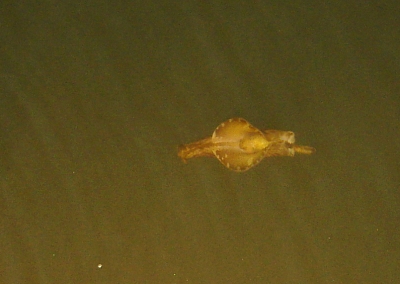
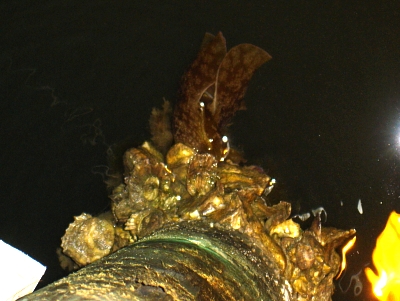
A few nights ago, around midnight, at dead tide I observed a Sea Hare Aplysia brasiliana swimming in the dock lights of our pier. The posts are covered with oysters and it looked as if the Sea Hare was feeding on the shells. I have been night fishing this area for almost 20 years and this was my first sighting of the creature. I did not know what it was until I discovered this Forum. Thanks for the extensive references. My question is, are there any populations numbers for the Gulf of Mexico? How common are these animals?
Locality: Orange Beach, 10 feet, Alabama, USA, Old River, , 04, May 2006, Aobut 50 yards south of the orange beach pass. Sandy bottom. Length: 10 to 12 inches . Photographer: Keith Ammons.
Thanks in advance
Keith Ammons
tourof12@aol.com
Ammons, K., 2006 (May 8) Sea hare in Alabama. [Message in] Sea Slug Forum. Australian Museum, Sydney. Available from http://www.seaslugforum.net/find/16547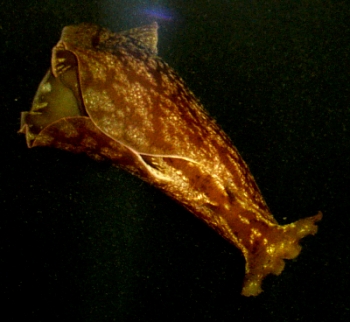
Dear Keith,
Your reaction 'I've been coming here for years and never seen them before' is quite a common response on seeing large Sea Hares. If you look through the messages concerning the different species of Sea Hares on the Forum you will see that people from the Mediteranean, Portugal, Australia and Florida have all responded the same way. I think there are at least two reasons why they are seldom noticed at a particular spot. The first is that humans tend to be creatures of habit and so come to a particular spot, such as a specific jetty each time, while Sea Hares, although they may be in an area regularly, and in large numbers, they may be in a different spot each time perhaps a hundred meters, perhaps a kilometer away from where they were last time. The other reason is that these 'events' are very short lived. You may find a group swimming for a couple of days, or a large aggregation may be there and then gone in a week. I guess you have looked at the Mass Mortality Fact Sheet where I discuss some of the possible reasons for these population fluctuations.
I don't know of any population surveys of Sea Hares in the Gulf of Mexico. I suspect such a survey would be very difficult as they are often hard to see when they are small and when they are large and most obvious they often are at the end of their life cycle and about to die. There distribution can aslo be very patchy. As to how common they are - in many species every individual has the potential to produce tens of thousands of planktonic larvae. After that it is all a bit of a lottery as the larvae have to feed in the plankton, avoid being eaten by plankton-eating predators and then find the right sort of place to settle down and grow to adulthood. Some larvae succeed but obviously most fail. The success rate surely differs from year to year so there will be good years and bad, but the messages coming to the Forum suggest that there are healthy populations of A. brasiliana and A. morio in the Gulf of Mexico.
Concerning you comment of them feeding on oyster shells. They could well be eating sea weeds growing on the shells, or they could just be tired. Although some species can swim for quite a long time, they are normally bottom dwellers, so I guess if they come across a 'rest stop' they make use of it.
Best wishes,
Bill Rudman
Related messages
-
Re: More swimming Sea Hares in Florida
From: Michele Harrison, May 3, 2010 -
More swimming Sea Hares in Florida
From: Carol Geisen, April 22, 2010 -
Re: Aplysia brasiliana from Florida
From: Kelsey Workinger, April 12, 2010 -
Re: Aplysia brasiliana from Florida
From: Karen Geck, April 12, 2010 -
Re: Aplysia brasiliana from Florida
From: Kevin Parker, April 7, 2010 -
Aplysia brasiliana from Florida
From: Betsy Geis, April 6, 2010 -
Gills of Aplysia brasiliana?
From: Linda Ianniello, March 5, 2009 -
Re: Aplysia brasiliana and swimming
From: Villand Bergerhoff, February 9, 2009 -
Re: Sea Hares on South Padre Island, Texas
From: Frances Noe, July 25, 2008 -
Sea Hare in Wilmington, North Carolina
From: Holly Cunningham, July 1, 2008 -
Re: Spanish Dancer (?) congregation in Florida
From: Brian Jackson, December 6, 2007 -
Re: Spanish Dancer (?) congregation in Florida
From: Brian Jackson, November 28, 2007 -
Re: Aplysia extraordinaria from nthn New Zealand
From: Jackie Coles, June 16, 2007 -
Re: Aplysia brasiliana & A. cervina
From: Vinicius Padula, February 23, 2007 -
Aplysia brasiliana & A. cervina
From: Carlos Meirelles, February 9, 2007 -
Re: Aplysia cervina from Brazil
From: Carlos Meirelles, February 1, 2007 -
Aplysia cervina from Brazil
From: Carlos Meirelles, January 31, 2007 -
Aplysia willcoxi - a junior synonym of A. brasiliana?
From: Anthony Fernando, December 22, 2006 -
Items from inside Aplysia brasiliana
From: Jo O'Keefe, June 28, 2006 -
Sea Hare from southern North Carolina
From: Jo O'Keefe, June 28, 2006 -
Re: Pink Sea Hare from Florida
From: Heather Clark, June 23, 2006 -
Sea Hare from Charleston, S. Carolina
From: Hannah Nelson-Horne., June 23, 2006 -
Pink Sea Hare from Florida
From: Heather Clark, June 21, 2006 -
Sea Hare from Sth Carolina, USA
From: Natalie Barbare, June 16, 2006 -
Sea Hare from South Carolina
From: Kassandra Humphrey, June 8, 2006 -
Sea Hares on South Padre Island, Texas
From: Ulli Schoenknecht, May 26, 2006 -
Re: Sea hare in Alabama
From: Keith Ammons, May 10, 2006 -
Re: Aplysia brasiliana and burrowing
From: Gustav Paulay, April 13, 2006 -
Sea Slug in the Intercoastal, Texas
From: Amy Peterson, March 28, 2006 -
Research reveals identity of alien creature
From: Juliet Jimenez, March 13, 2006 -
Need help identifying this alien creature!
From: Juliet Jimenez, March 13, 2006 -
Re: Swimming Aplysia fasciata from Spain
From: Adrienne Zedella, March 4, 2006 -
Re: Burrowing Sea Hares
From: Joey Lau, August 19, 2005 -
Sea Slug in Pompano Beach, Florida
From: Sandy Kerr, March 4, 2005 -
Sea Hare? from Florida
From: Millicent Parker, February 15, 2005 -
Nudibranch from Galveston Bay , Texas
From: Damian Menning, February 11, 2005 -
Aplysia brasiliana swimming
From: Richard Shanahan, March 17, 2004 -
Swimming Sea Hare in Florida
From: Richard Shanahan, March 16, 2004 -
Swimming Sea Hare from Florida
From: Allen Peterson, January 22, 2004 -
Aplysia brasiliana from Texas, Gulf of Mexico
From: Eric Carpenter, July 18, 2003 -
Aplysia from Florida
From: Hollie Greer, May 29, 2003 -
Baby Aplysia brasiliana swimming
From: Anne DuPont , April 18, 2003 -
Sea Hare - Ft Myers Beach, Florida
From: Cindy Volk, February 25, 2003 -
Sea hares everywhere, Coastal Alabama
From: Becky Roland, September 4, 2002 -
Hundreds of slugs in Florida
From: Trevin Bernarding, June 20, 2002 -
Thanks for info
From: Bruce de Haas, June 17, 2002 -
Swimming slug photos from W. Africa
From: Bruce de Haas, June 1, 2002 -
Sea snail or slug? from Florida
From: Mary Bigari, May 22, 2002 -
Sea Hare Question
From: Dana Keith Farnsworth, May 15, 2002 -
Black swimming slug
From: Bruce de Haas, April 30, 2002 -
Re: Aplysia - Mass mortality in Florida
From: Daren Hoffman, January 9, 2002 -
Does Aplysia brasiliana have a mating season?
From: Ray, June 28, 2001 -
Swimming slugs from North Carolina
From: Rhenee Helms, June 26, 2001 -
Doubts about Aplysia brasiliana
From: Luis Ernesto Arruda, June 5, 2001 -
Re: Burrowing Sea Hares
From: Toni Yeomans, April 23, 2001 -
Burrowing Sea Hares
From: Bill Rudman, April 22, 2001 -
Sea Slug from the west coast of Florida
From: Nancy Kielich, April 16, 2001 -
Re: Swimming slug in Florida
From: Rob Porter, March 30, 2001 -
Swimming slug? in Florida
From: Rob Porter, March 25, 2001 -
Aplysia brasiliana from Florida
From: Debby, March 21, 2001 -
Re: Aplysia brasiliana from Florida
From: Mike Schmale, March 21, 2001 -
Aplysia brasiliana and burrowing
From: Melanie , March 13, 2001 -
Re: Daughter needs info ....
From: Grace Brookshire, February 16, 2001 -
Please help......daughter needs info
From: Grace Brookshire, February 15, 2001 -
Re: Was it a sea slug?
From: Roy Harrell, August 21, 2000 -
Was it a sea slug?
From: Roy Harrell, August 20, 2000 -
Florida Sea Slugs
From: Sharon, May 3, 2000 -
Aplysia brasiliana from Brazil
From: Carlo Magenta, December 17, 1999 -
Re: Aplysia brasiliana mass mortality
From: Mike Schmale, November 16, 1999 -
Identity of Aplysia brasiliana
From: Paul Hamilton, November 2, 1999 -
Aplysia brasiliana & swimming
From: Bill Rudman, October 15, 1999 -
Re: Aplysia - Mass mortality
From: Anne Dupont, October 15, 1999 -
Aplysia brasiliana and swimming
From: Bill Rudman, September 9, 1999 -
Sea Hare West Palm Beach Florida
From: Kathy Dougherty, May 13, 1999 -
Brown-winged sea slug from Florida
From: SB, May 12, 1999 -
Re: Sea Hare? swimming in Florida
From: Esat Atikkan, May 4, 1999 -
Sea Hare? swimming in Florida
From: Esat Atikkan, April 27, 1999